

Share this Story
A Dream Deferred: Black Excellence, Voice, and Resistance
Students, scholars, artists, and community partners examine freedom through the lens of Black creativity
University News | February 20, 2026
 For generations, the American Dream has promised freedom and opportunity—yet for many Black Americans, that promise has been delayed, denied, and deferred. Inspired by Langston Hughes’ enduring question, “What happens to a dream deferred?” Virginia Wesleyan University hosted a powerful program on February 19 in the Susan S. Goode Fine and Performing Arts Center that examined freedom promised, postponed, and persistently pursued across generations.
Held during Black History Month, the program framed Black excellence not simply as achievement or acclaim, but as sustained moral pressure on a nation still grappling with its contradictions. Through music, performance, poetry, and visual art, the evening invited reflection on who bears the cost when freedom is promised but not delivered—and how creative expression becomes both witness and resistance.
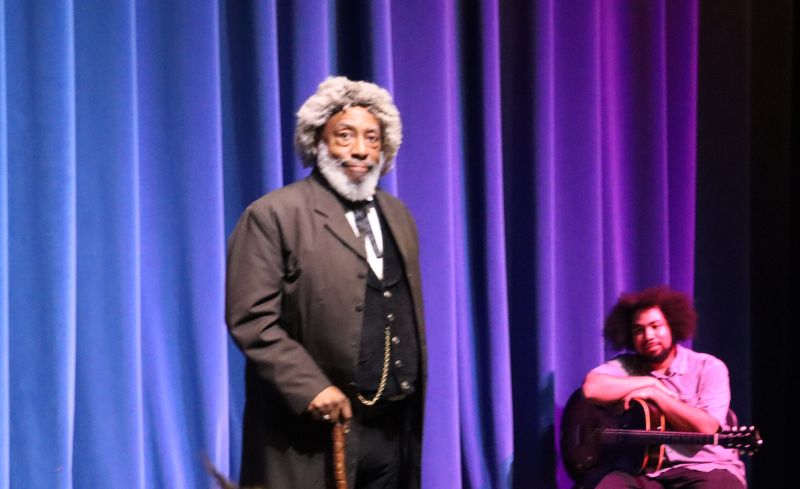
A pre-program reception featured works by local artists, opportunities to engage with community organizations, and music by the VWU Jazz Ensemble under the direction of Associate Professor of Music Jason Squinobal. The formal program highlighted performances by internationally recognized artist BJ Griffin, a compelling historical reenactment of Frederick Douglass by author and performance poet Nathan Richardson, spoken-word presentations by Virginia Wesleyan students, and visual art by students and alumni, including Clayton Singleton ’94, whose Tupelo Honey appeared on the event flyer and program.
Student presenters included Brielle Carter, Madison Hayes, Demeir Pollard, Jamal Jones, Malik Williams, BreAnna Downing, London Collett Patt, Brandyn Davis, Tre’Sean Todd, and Isaac Samual, whose performances reflected themes of identity, justice, resilience, and hope.
“Art provides the means to speak truth to power and to champion the causes of freedom, humanity, and social justice,” said Associate Professor of Sociology and Criminal Justice Jeff Toussaint, the program’s chief organizer. “By deepening empathy and reminding us that creativity is inseparable from civic responsibility, artistic expression becomes one of our most powerful engines for remembrance and social change.”
Toussaint said the idea for the event emerged during his commute while listening to an NPR report on the upcoming 250th anniversary of the Declaration of Independence in 2026. Reflecting on the removal of key moments and memorials tied to Black history, he felt compelled to create a program that would honor Black contributions to the American story while ensuring that students felt seen and empowered to tell that story themselves.
“I wanted an event that reflected the joy, resistance, contributions, and legacy of Black Americans,” Toussaint said. “Art and poetry enable us to speak truth to power and to one another. My hope was to evoke Martin Luther King Jr.’s vision of the beloved community—one rooted in freedom, inclusion, and justice. While diversity is essential, inclusion remains the ongoing goal. Listening to music, poetry, and reflection helps us understand who we are and who we aspire to be as a community and as a nation.”
The planning team included Associate Professor of English Rebecca Hooker; Robert Nusbaum Center Director Craig Wansink and Associate Director Kelly Jackson; Assistant Professor of English Sara Ryan; Shawn Smith of Hampton University; and Alicia Peoples of Tidewater Community College.
“Community building requires care, intention, and spaces where people feel seen, heard, and connected,” said Peoples. “Grounded in historical context and authenticity, this program used the creative arts to strengthen belonging, support emotional wellness, and empower the broader community.”
Hooker said that she was most impressed by the students and the way they embraced the material.
“We gave them options to choose from, and they chose what spoke to them. I was surprised and impressed by some of the choices they made. I was impressed by the original poems, as well— they were powerful personal statements. I was also impressed by how the audience responded to the students' presentation. They were moved by the poems and the songs, so I felt like we had a very communal setting throughout the event.”
The evening was made possible through collaboration with the VWU Department of Africana Studies and Robert Nusbaum Center, along with community partners including the Virginia African American Cultural Center, Freedom Virginia, Affordable Virginia, and Teens With A Purpose. Toussaint also expressed gratitude to Amelia Ross-Hammond of the Virginia African American Cultural Center and Eddie Seay for their support and participation.
“This event brought students, faculty, alumni, and community members on our campus to celebrate the African-American experience,” noted Hooker. “To me, this is the best example of what Virginia Wesleyan's role is in all our collaborative communities. We can bring people together to interact with one another, to share our talents and our knowledge, to foster understanding about our shared experiences in the world. It also provided visibility and an opportunity for our African-American students to share their interests and talents. Dr. Touissant mentioned in his opening remarks that he wanted the students to feel seen, for their life experiences to be validated, and I think this event did that for them.”
“A Dream Deferred” was part of the Robert Nusbaum Center’s Spring 2026 series, Freedom: Too Important Not to Examine, which—on the eve of the nation’s semiquincentennial—invites the campus and broader community to confront freedom in all its promise, contradiction, and consequence.