


Share this Story
Are You Free to Trade? Exploring the Boundaries of Economic Freedom
VWU faculty member challenges assumptions about choice, access, and responsibility in today’s marketplace
University News | April 7, 2026
 What does it really mean to be “free” in a market economy?
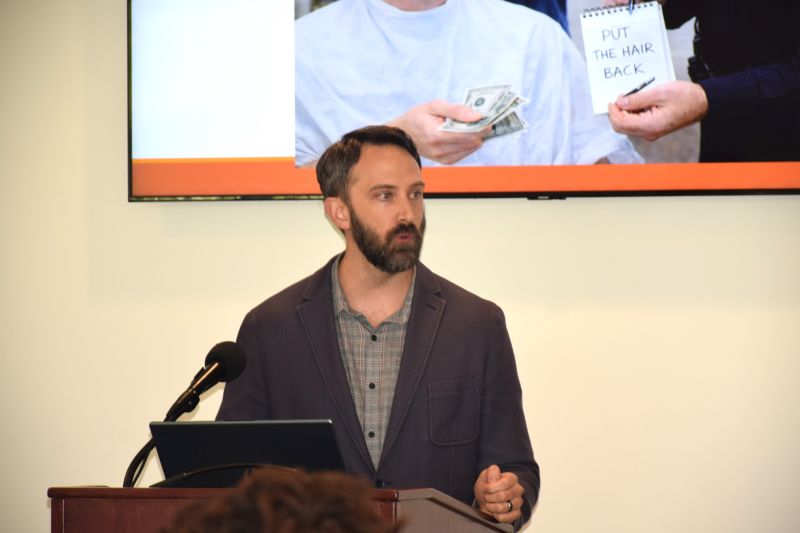
That was the central question explored by VWU Associate Professor of Management, Business, and Economics Garrett Wood, Ph.D., during his recent talk, "Are You Free to Trade?," held April 2 in Brock Commons. Hosted by the Robert Nusbaum Center, Wood’s thought-provoking presentation invited the campus community to reconsider the extent of personal choice in economic decision-making—and the unseen forces that shape it.
Wood, whose teaching and research explores topics ranging from public policy and everyday economic behavior to conflict economics and the political economy of war gaming, is a former Surface Warfare Officer in the U.S. Navy.
“These are not simply economic questions—they're questions about the boundaries of personal freedom in a complex society,” Wood explained, reframing everyday financial decisions as part of a much larger philosophical and societal conversation.
From the outset, the discussion challenged assumptions. Attendees were asked to consider a series of seemingly straightforward questions: Can you sell your kidney? Choose your own investments? Buy the house you want? While markets often suggest unlimited opportunity, the reality is far more nuanced.
“Markets offer choice and opportunity, but laws and subjective ethics constrain those choices and opportunities,” Wood said.
By examining these constraints, Wood highlighted how economic systems are influenced not only by supply and demand, but also by regulations and the moral considerations of legislators. The result is a marketplace that is structured as much by limitation as it is by possibility.
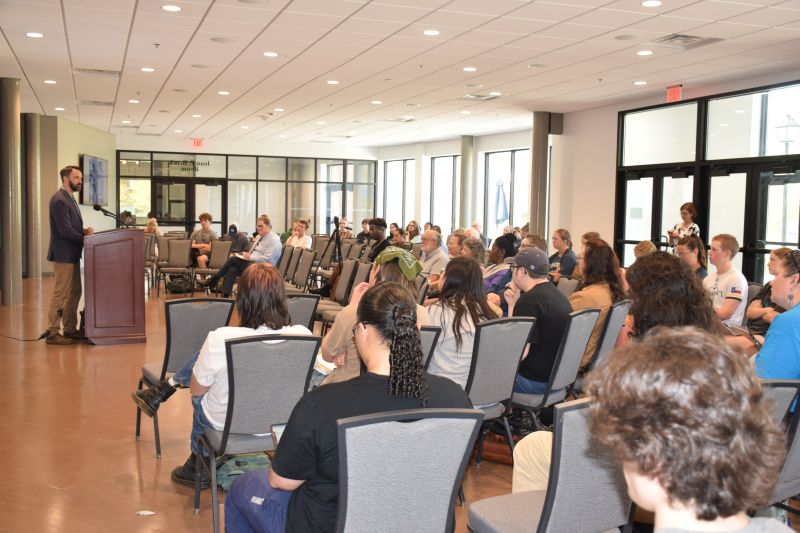 The conversation also underscored the role of power in determining those limits. Who sets the rules? Who benefits from them? And who is left out? These questions, Wood suggested, are essential to understanding how economic freedom functions in practice.
At its core, the presentation encouraged attendees to think critically about the intersection of economics and personal liberty. Rather than viewing markets as neutral spaces of exchange, Wood presented them as dynamic systems shaped by human decisions and societal values.
He left the audience with a question that lingered well beyond the session:
“How free are we to trade—and who decides?”