


Share this Story
Frames of Freedom: Norman Rockwell, Gordon Parks, and the Visual Language of Justice
Professors Derek Eley and John Rudel explore how art shapes understanding and inspires action
University News | January 21, 2026
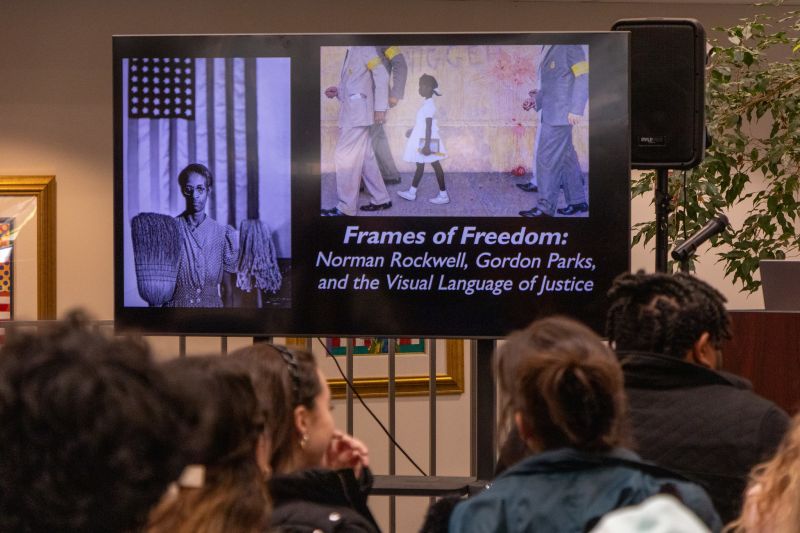 Virginia Wesleyan University’s commemoration of the life and legacy of Dr. Martin Luther King Jr. opened with a compelling program hosted by the Robert Nusbaum Center. Titled “Frames of Freedom: Norman Rockwell, Gordon Parks, and the Visual Language of Justice,” the event examined how visual storytelling has shaped public understanding of dignity, equality, and freedom, and how art can inspire meaningful action.
Led by Professors of Art Derek Eley and John Rudel, the presentation launched a week of events honoring Dr. King’s enduring ideals. Through iconic works by Gordon Parks and Norman Rockwell, the speakers explored how images challenge stereotypes, spark moral reflection, and advance social change—an influence that continues to resonate today.
 Craig Wansink, director of the Robert Nusbaum Center, set the tone for the event with a reflection on the transformative power of art.
“In life, you’re either a thermostat or a thermometer—you’re either setting the temperature or reacting to it,” Wansink said. “Art didn’t just document the civil rights movement; it pushed it forward. It created the temperature in which it could happen.”
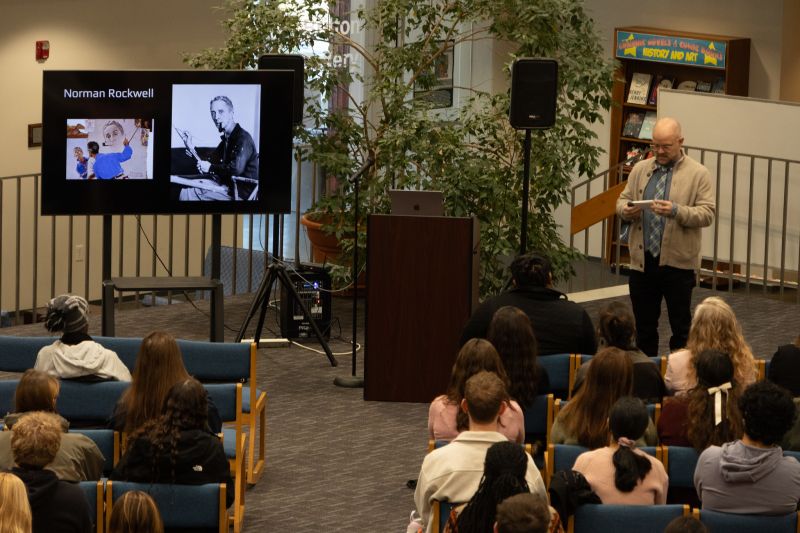
Rudel traced the history and remarkable career of Norman Rockwell, whose name has become synonymous with warmth, humor, and scenes of everyday American life. “When we say something looks ‘Rockwell-esque,’ we’re invoking a familiar world,” Rudel noted. “Today, we take a broader look at an artist who could mock, command, and empower.”
Sharing several of Rockwell’s most captivating images, Rudel highlighted his use of saturated color and carefully triangulated human interactions that keep the viewer’s eye moving across the canvas. He discussed Rockwell’s prolific career—from serving as art director for Boys’ Life and creating imagery for brands such as Coca-Cola and Campbell’s Soup, to his 47-year tenure at The Saturday Evening Post, where he produced 322 covers, and later work for Look Magazine.
“It’s impressive to realize the scale of his impact given the relatively humble studio he maintained in Stockbridge, Massachusetts,” Rudel said. “Rockwell was a highly trained, extremely driven master storyteller who could distill an entire narrative into a single frame.”
Rudel also analyzed Rockwell’s powerful depiction of Ruby Bridges in “The Problem We All Live With” (1964), created as a two-page spread for Look. “His imagery was ubiquitous,” Rudel explained. “It framed how people understood popular culture—and, in many ways, the story of America at that moment.”
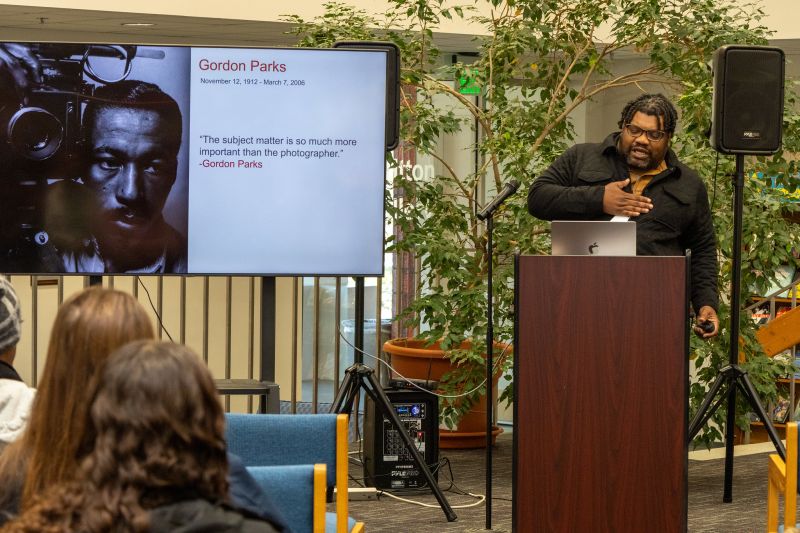 Eley then turned the focus to Gordon Parks, sharing a personal story of how his own artistic path shifted during college when a fellow student pressed Parks’ book Half Past Autumn into his hands. “From that moment, I was hooked on photography,” Eley said. “I was amazed by the range and power of Parks’ images. I carried that book around like a bible.”
As Eley explained, Parks—working as a Black man in pre–civil rights America—became the first Black photographer for Life Magazine and also worked for Time and Vogue. Eley detailed Parks’ early life and career, emphasizing how he navigated an America that was often hostile to Black men while remaining steadfast in his commitment to telling the truth through images.
Eley concluded with an analysis of Parks’ iconic photograph “American Gothic” (1942), created after Parks moved to Washington, D.C. to work for the Farm Security Administration.
“Sent out to learn about life in the city, Parks encountered profound racism,” Eley said. “His supervisor encouraged him to focus on the people around him—to tell their stories.”
That guidance led Parks to photograph Ella Watson, a charwoman in his workplace, reimagining Grant Wood’s 1930s painting American Gothic. The resulting image has since been recognized by Time as one of the most influential photographs ever taken—an enduring testament to the power of art to confront injustice and illuminate truth.