

Share this Story
Honoring Black Joy Throughout the Diaspora
The campus community gathered for a student-centered celebration of culture, history, and identity
University News |February 27, 2026
Continuing the spirit of Black History Month, the campus community gathered at the Athenaeum on February 23, for “Honoring Black Joy Throughout the Diaspora,” an evening celebrating culture, history, and identity. This student-centered c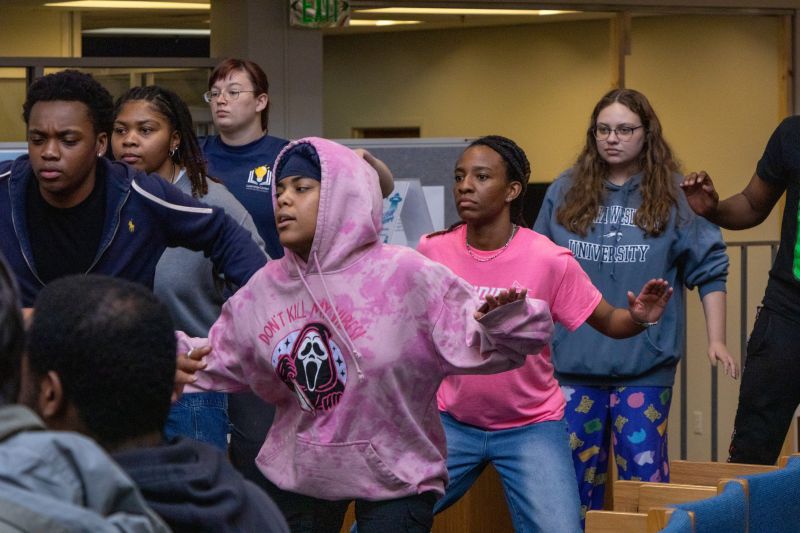 elebration featured dance, music, spoken word, step, and powerful cultural storytelling, including a reenactment, highlighting the richness and diversity of the Black diaspora.
The event was made possible by an Arts in Practice grant from the Virginia Commission for the Arts and was organized through Student Success Coordinator Katrina Hamilton-Lawal, a member of the President's Council on Inclusive Communities (PCIC). Bringing both passion and purpose to the initiative, Hamilton-Lawal, along with Professor Trey Delpo, and World Stage worked closely with students to ensure the program reflected their voices and creativity.
Student performances highlighted a wide range of musical and dramatic talents, representing different styles and generations.
Senior Madison Hayes served as master of ceremonies, opening the evening before a moving vocal performance of “Lift Every Voice and Sing,” led by Hamilton-Lawal and first-year student Leah Hilliard. Often referred to as the Black National Anthem, the hymn was written in 1900 by James Weldon Johnson and composed by his brother, John Rosamond Johnson. The crowd joined in song, demonstrating strong support and unity as a campus community.
Hilliard followed with an emotional performance of “One Voice” by Brandy, emphasizing unity, shared humanity, and the power of using one’s voice for love instead of division.
Senior Pauly Bolt delivered a moving two-part performance blending blues music and American theater. He began with a blues selection rooted in African American musical tradition, a genre long associated with resilience, storytelling, and emotional truth, before transitioning into a monologue from “Gem of the Ocean” by August Wilson.
Set in 1904, the play explores the legacy of slavery and the ongoing search for freedom and identity. Bolt recited lines from the character Caesar Wilks that reflected perseverance in the face of inequality.
“I got to play the hand that was dealt to me,” Bolt recited. “The race you got to run is different than somebody else’s. Maybe it’s got more hills. It’s longer. But this is what I got. Now what to do with it?”
Junior Michael Leslie Morris honored his grandfather’s legacy through a powerful reading of “Sonnet” by James Weldon Johnson. Drawing on themes of perseverance, faith, and moral courage, he reflected on the strength and resilience that defined his grandfather’s life, connecting his personal history to a broader tradition of endurance and hope.
First-year student Babatunde Sopade presented an original reenactment of Omar Ibn Said, a highly educated Senegalese Muslim scholar who was enslaved in the United States. Despite widespread efforts to suppress literacy among enslaved people, Omar Ibn Said wrote extensively in Arabic, including his 1831 autobiography, the only known surviving autobiography in Arabic by an enslaved person in the United States.
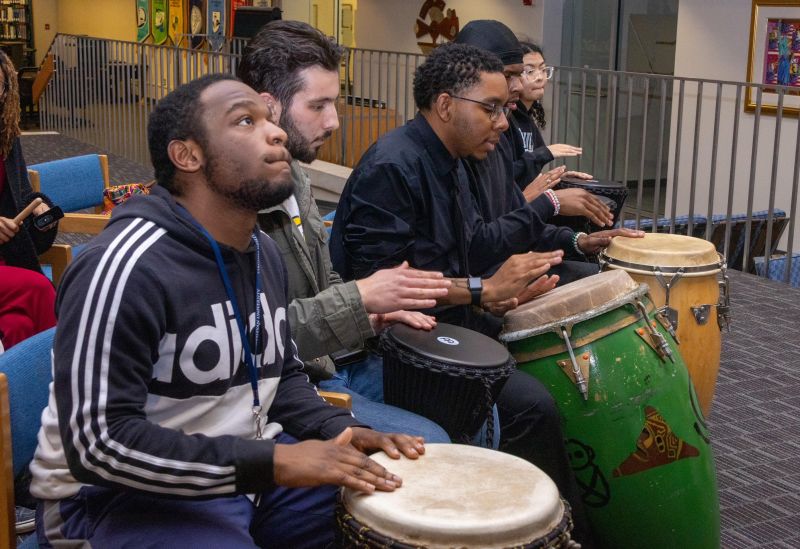 The evening continued with a lively dance and drumming ensemble led by the VWU’s partner, the Tidewater African Cultural Alliance (TACA). Performers Rita Addico Cohen, Nana Yaw Ainoo, Dmitri Clawson, and Felix Valderrama energized the audience before dividing attendees into two groups for an interactive workshop, teaching traditional drumming patterns and dance movements from both African and Caribbean traditions.
At the conclusion, TACA performer Cohen reflected on the shared elements across cultures.
“That’s how we connect to each other across oceans, across countries,” she said. “If you remove the lyrics and the language, the songs carry the same meaning — the underlying cadence is the same.”
Throughout the evening, attendees were immersed in a tapestry of Black culture spanning West, Central, East, and Southern Africa, alongside African American, Afro-Latino, Afro-Caribbean, and Afro-Asian experiences.
Hamilton-Lawal closed the evening with reflections on the global influence of African culture.
“All throughout the world, we see the influence of African culture,” she said. “If you think about it, regardless of race, look at the instruments we use — there’s the drum, that universal beat that brings us together. For our ancestors, it was a way of communicating. To all of our students, especially African American students across the diaspora, I want to leave you with this.”
She concluded with words from poet and civil rights activist Maya Angelou:
You may write me down in history
With your bitter, twisted lies,
You may trod me in the very dirt
But still, like dust, I’ll rise.
Virginia Wesleyan continues its partnership with TACA, which offers free African dance classes for students and staff every Tuesday from 6:15–7:15 p.m. at the Batten Student Center.
Learn more about TACA dance classes and Black Storytellers.