


Share this Story
Inaugural Life Raft Debate Showcases the Value of Academic Disciplines
Faculty use wit, wisdom, and a touch of humor to argue what knowledge humanity can’t live without
University News | March 26, 2026
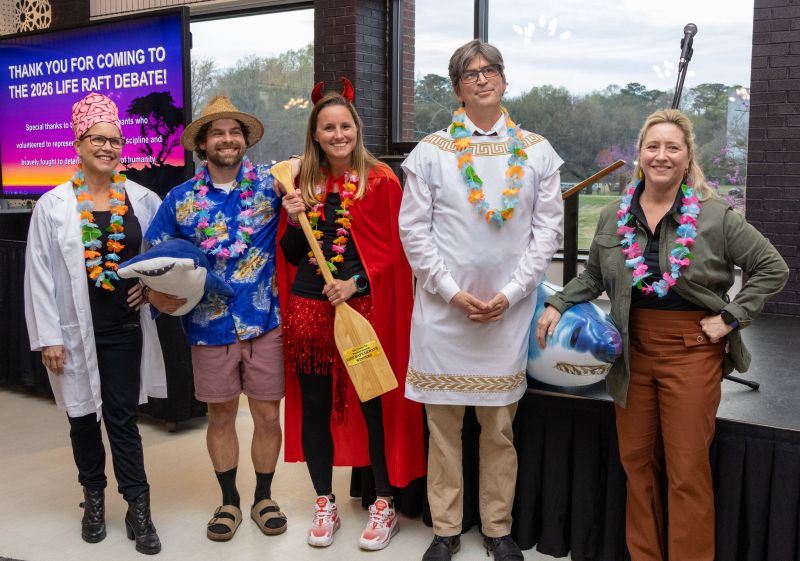 Virginia Wesleyan University’s inaugural Life Raft Debate made a splash on March 25 in Boyd Dining Center, blending intellectual rigor with imaginative fun. Sponsored by the Office of Student Success, the event—popular at colleges and universities nationwide—invited faculty to make the ultimate case: why their discipline deserves to survive the end of the world.
The premise? Equal parts absurd and inspired.
Shark Apocalypse. One Life Raft. One Professor Survives.
After a bizarre evolutionary twist turns sharks into amphibious super-predators, humanity teeters on the brink of extinction. On a distant island, just one life raft remains—and five professors must determine which field of knowledge is most essential to rebuilding civilization.
In this high-stakes (and highly entertaining) scenario, each faculty member argued for the survival of their discipline, while one “Devil’s Advocate” challenged the very notion that humanity—or any field of study—is worth saving at all. The audience, armed with phones, QR codes, and strong opinions, ultimately decided who would claim the lone seat on the raft.
Serving as captain, emcee, and moderator, Associate Vice President for Student Success Crit Muniz guided the evening, introducing participants and laying out the rules. Each professor had five minutes to deliver opening arguments, striking a careful balance between lecture and levity. There was then opportunity for a rebuttal from each of the contenders, followed by responses to targeted questions.
Dressed to represent their disciplines and armed with persuasive presentations, the debaters cajoled, pleaded, and pontificated their way through a lively battle of ideas.
Clair Berube, associate professor of education and Defender of Education, made a sweeping case for her field’s foundational role:
“I defend the single most important profession on earth—the ultimate cornerstone of human progress: education. Without us, none of the other disciplines even exist. Every occupation you are studying for right now exists because a teacher taught it… Education is what will save the world!”
Representing the humanities, Professor of Classics Ben Haller turned to history and philosophy for inspiration:
“Omnia Disce: you will see afterwards that nothing is superfluous. The Humanities are not merely diversions—they equip us to live well, to pursue excellence, and to ask the questions that drive all other fields… As we rebuild after this catastrophic shark attack, it is the Humanities that will help us record knowledge, inspire curiosity, and guide inquiry.”
Gabi Martorell, professor of psychology and Defender of Psychology, brought the focus to human behavior under pressure:
“Every bad decision starts in the mind—panic, fear, groupthink, conflict. Psychologists help keep morale up and conflict down… Without psychology, this becomes the type of group project where no one communicates, one person does all the work, and somebody cries by day two. Vote for us—or enjoy your floating Lord of the Flies.”
From the sciences, Zachary Topor, assistant professor of marine biology and Defender of Biology, emphasized practical survival:
“If only there were a way to systematically test our problems, find a collaborative path forward, and create real solutions. Oh wait—that’s what science does every day. We don’t just talk about survival—we engineer it. And frankly, if we’re going to make it out of this, we’re going to need to build a bigger boat.”
Then came the curveball.
Lauren Stephens, assistant professor of sport and recreation professions, embraced her role as Devil’s Advocate by questioning the entire premise:
“Is humanity, as it exists today, even worth saving? We’ve poisoned our oceans, normalized exploitation, and ignored the consequences of our actions… Survival isn’t the same as deserving to survive. If we rebuild without that honesty, we’ll repeat everything that doomed us in the first place.”
The central question of the evening—which faculty member should survive for the sake of humanity?—was ultimately decided by audience vote.
In a fitting twist, the crowd chose the voice of skepticism.
Dr. Stephens, the Devil’s Advocate, emerged victorious—claiming the life raft oar and, perhaps, the future of humanity itself.