
Share this Story
Justine L. Nusbaum Lecture: High for a Higher Power?
God, drugs, and religious freedom explored by author and scholar Brad Stoddard
University News | February 13, 2026
 America guarantees freedom of religion—but what happens when belief pushes legal and cultural boundaries?
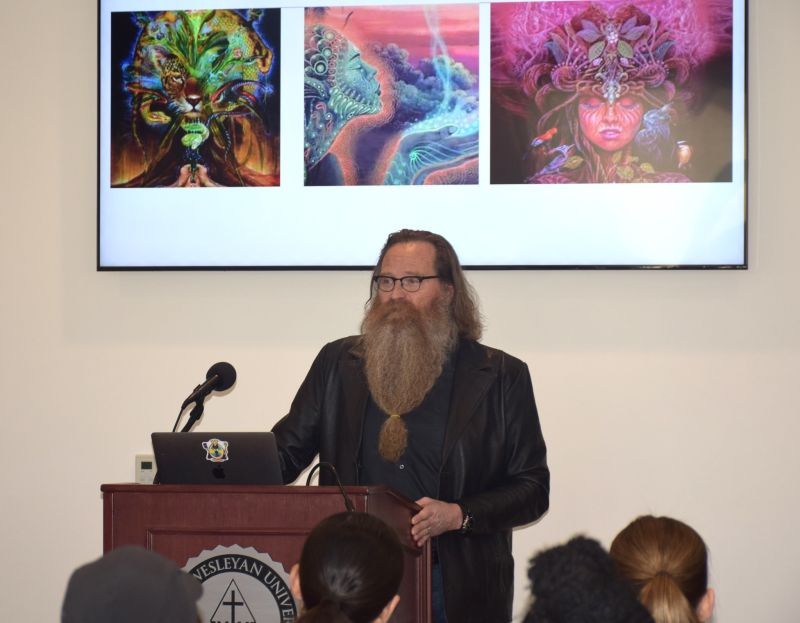
Drawing on real cases involving psychedelic sacraments and religious-freedom claims, Brad Stoddard, associate professor of religious studies at McDaniel College, examined how law, belief, and power intersect in contemporary America. His lecture raised challenging questions about sincerity, authority, and who ultimately gets to define what counts as “real religion.”
Hosted by the Robert Nusbaum Center, the 2026 endowed lecture honored the life of Justine Nusbaum (1900–1991), a local humanitarian whose compassion and generosity reached across religious, racial, and national lines.
A specialist in religion and American prisons, entheogens, religion and the economy, public policy, and theory and method, Dr. Stoddard is the author of The Production of Entheogenic Communities in the United States. His most recent work explores religious communities centered on psychoactive substances.
“I’m going to talk about drugs and psychedelic churches today,” Dr. Stoddard told the packed audience in Brock Commons on February 12, “but what I’m most interested in is the concept of religious freedom and questioning some of the things we are commonly taught—namely that religious freedom is always good, always possible, and that the laws designed to protect it actually succeed.”
Dr. Stoddard has researched psychedelic churches for nearly a decade, noting what many scholars describe as a “psychedelic renaissance.” Pharmaceutical companies and universities are investing heavily in research on psychedelic substances, particularly for mental-health treatment and end-of-life care. At the same time, he said, more Americans are using psychedelics in explicitly spiritual or religious contexts than at any previous point in U.S. history.
He outlined several pathways through which individuals engage entheogens: contract facilitators, informal groups, and organized churches—including those that pursue legal recognition. The term entheogens refers to psychoactive substances used in religious or spiritual settings to foster feelings of inspiration, divine connection, or insight.
Focusing on ayahuasca, a psychoactive Amazonian brew, Dr. Stoddard discussed its neurological effects, reported visionary experiences, and its longstanding use among Indigenous communities. He also traced the emergence of ayahuasca churches in the United States and the legal strategies they employ to seek protection under religious-freedom law.
“The government and the courts often use Christian models of religiosity to evaluate non-Christian groups,” he explained. “Lawyers understand you can’t simply do anything you want—you have to conform your practices to recognizable forms of ‘religion.’”
This dynamic, he argued, produces a central tension: while religious-freedom laws are designed to protect belief and practice, they can also limit how communities express their spirituality.
“Religious freedom in the United States exists,” Dr. Stoddard concluded, “but often only for those willing to reshape their practices to fit legal and cultural expectations.”
The lecture invited attendees to reconsider familiar assumptions about religion, law, and personal liberty—continuing the Robert Nusbaum Center’s mission to foster thoughtful dialogue on complex issues.
View Dr. Brad Stoddard’s full lecture here.
Learn more about the Robert Nusbaum Center at VWU.