Share this Story
SHIFT: Endangered & Extinct Languages Opens at Norfolk Academy, Showcasing VWU Faculty
Professors Derek Eley and John Rudel explore identity, memory, and meaning through the evolving power of language
University News | March 5, 2026
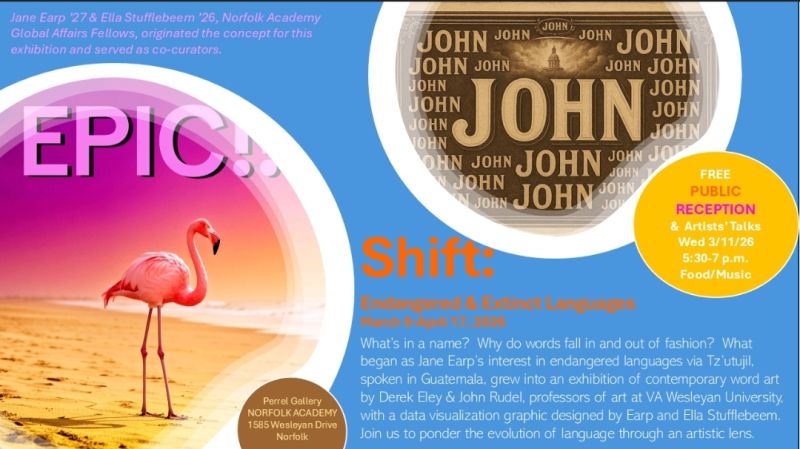 When conversations about endangered and extinct languages begin, they often center on preservation and loss. But SHIFT: Endangered & Extinct Languages, opening March 9, in the Perrel Gallery at Norfolk Academy, invites viewers to consider language in motion—how it evolves, dissolves, resurfaces, and shapes identity.
On display are the works of Virginia Wesleyan University Professors of Art Derek Eley and John Rudel, whose distinct artistic approaches examine language not only as communication, but as culture, memory, and self-definition. The exhibit will be open to the public Wednesday, March 11, from 5:30–7 p.m., with Artists’ and Curators’ Talks at 6 p.m.
A Contemporary Lens on Language
According to Norfolk Academy Art Teacher and Perrel Gallery Curator Betsy DiJulio, SHIFT trains “a contemporary artistic lens on the topic of endangered and extinct languages.” The exhibition is the brainchild of NA Global Affairs Fellows Jane Earp ’27 and Ella Stufflebeem ’26, whose interest in language preservation began with Earp’s introduction to Tz’utujil during a trip to Guatemala.
“Last year, I was approached by two NA Global Affairs Fellows, Jane Earp ’27 and Ella Stufflebeem ’26, with an exciting exhibition concept,” DiJulio said. “Their idea involved exhibiting artists whose work—including the possibility of sound-based art—explores the topic of endangered and extinct indigenous languages.”
While research uncovered no such artists within close proximity to Norfolk, the curatorial team broadened its scope.
“We began to consider local contemporary artists who work with language, even if not indigenous,” DiJulio explained. “A query to Karen Rudd, the head of Norfolk Arts, led us to two art professors who teach next door at Virginia Wesleyan University.”
DiJulio had previously worked with Rudel but welcomed Eley as “a new artist on my radar.” After pitching the concept, the artists accepted. “We all met to discuss parameters, and then we stepped aside and let them do what artists do best: create and innovate.”
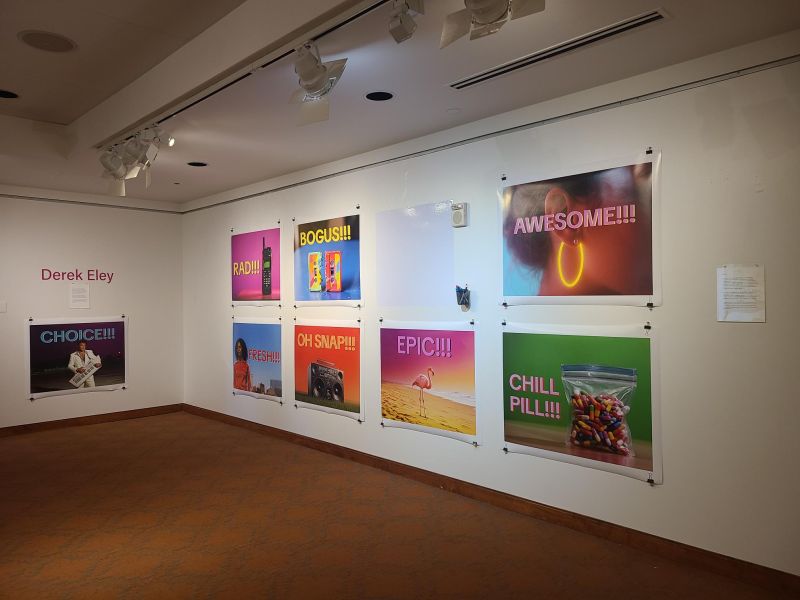 Word Up: The Rise and Fall of Slang
In his series Word Up, Derek Eley explores the cyclical life of slang—how informal language rises to prominence, fades from use, and occasionally resurfaces.
“Derek Eley’s work investigates slang and its adoption by generations and subcultures,” his artist’s statement explains. “He is fascinated by informal language and how it plays into semantics.”
Eley notes that for slang to enter everyday vocabulary, it must be “championed by pop culture.” Yet popularity is fleeting. Words fall out of fashion, only to be “intermittently resuscitated when original adopters use it within their own circles.”
Created using Flora, an artificial intelligence app that generates visuals from written prompts, and refined in Adobe Photoshop, the works evoke nostalgic imagery from the 1980s and 1990s. Flamingos reminiscent of the opening credits of an ’80s detective show and scenes inspired by breakdancing films featuring track suits form the backdrop for slang terms that defined entire eras.
“The marriage of image and text ranges from being harmonious to slightly disjointed,” Eley writes—mirroring the sometimes awkward, always evolving relationship between generations and their words.
By examining slang—language that is constantly endangered by time—Eley highlights how even informal speech reflects cultural shifts and collective memory.
What’s in a Name?
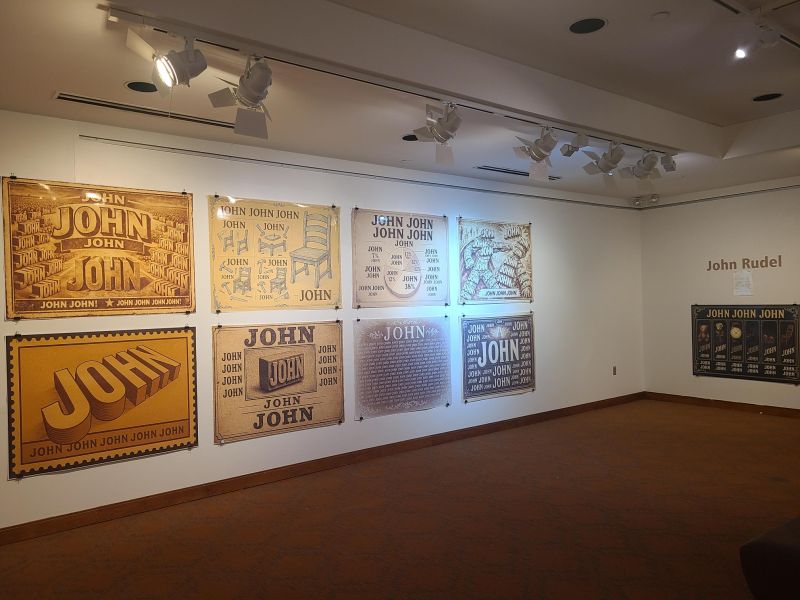 For John Rudel, language becomes personal in The JOHN Posters, a body of work that began with a simple premise: repeating his own first name.
“What’s in a name?” Rudel asks.
“The JOHN Posters emerged from a simple premise: repeating a name, in this case, the artist’s name: John (Rudel). But the body of work expanded into an inquiry about identity, memory, and how the traditions and values of a culture are built on small, every day, and mundane aspects of human existence.”
Borrowing visual cues from vintage advertisements, postage stamps, instructional diagrams, comic books, and informational charts, Rudel renders each poster large and in sepia tones. The effect is that of an artifact—something at once historical and imagined.
Rudel invites viewers to consider how names feel deeply personal yet are profoundly shared. “Our names are simultaneously not ‘ours.’ They have long and complex cultural histories,” he explains. The name John, for example, is biblical, slang for a restroom, shorthand in a “Dear John letter,” and the everyman in “John Doe.”
“When we repeat a name over and over, it becomes abstract, like a pattern or texture and, in that way, serves as a metaphor for the fragility of identity,” Rudel says. “In a world in which personal branding has become paramount, The JOHN Posters blur rather than sharpen identity.”
Ultimately, his work examines “the overlap between what is both enduring and dissolvable in identity, what is inherited and what is invented, what we hold onto and what we will inevitably leave behind.”
Collaboration and Innovation
DiJulio expressed gratitude to the student curators for their dedication, including the creation of a data visualization map to accompany the exhibit. “I am especially grateful to Ella and Jane for their vision and commitment—including their data visualization map—to the artists for trusting us with their ideas, and to Jack Gibson for his support as the director of the Batten Leadership Program,” she said.
SHIFT encourages active engagement, featuring interactive stations that invite viewers to reflect on their own relationship with language—words spoken, forgotten, revived, and reimagined.
As language shifts, so too does culture. Through contemporary art, SHIFT reminds us that even when words disappear, their echoes remain—shaping identity, memory, and meaning for generations to come.