

Share this Story
Unchained Waters: Freedom and Control in a Thirsty World
Faculty panel explores the global water crisis and the meaning of access, equity, and power
University News | March 27, 2026
 What does water have to do with freedom? At Virginia Wesleyan University, a recent panel challenged attendees to consider just how deeply the answer shapes our world.
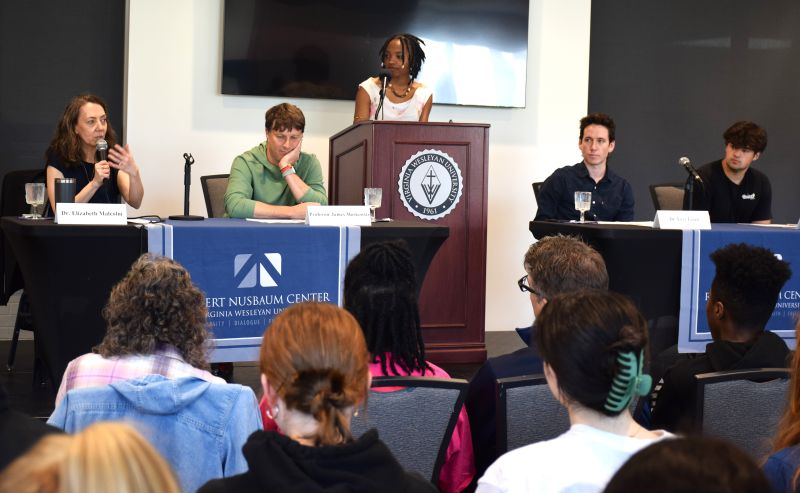
Held March 26 in Brock Commons, “Unchained Waters: Freedom and Control in a Thirsty World” brought together faculty experts and a global practitioner for a timely and thought-provoking discussion on access to clean water. The event, hosted by the Robert Nusbaum Center as part of its “250 Years of Freedom” series, was presented in partnership with VWU’s student chapter of Thirst Project.
Moderated by Laila Jones ’27—president of VWU’s Thirst Project chapter and the University’s 2026 recipient of the Mavis McKenley Award—the conversation examined how water intersects with issues of justice, power, and human rights. From the transformative impact of a single well to the destabilizing effects of water scarcity, panelists encouraged the audience to rethink assumptions and recognize the urgency of the global water crisis.
The panel featured Dr. Elizabeth Malcolm, Batten Professor of Ocean and Atmospheric Sciences and Director of Sustainability; James Moskowitz, Batten Lecturer in Political Science and Coordinator of the NATO Partnership; Dr. Levi Tenen, Assistant Professor of Philosophy and Ethics Bowl coordinator; and Andrew Reese, Director of School Programs at Thirst Project.
Each speaker approached the topic through the lens of their discipline. Malcolm emphasized the environmental stakes, describing water as a “precious resource” that must be managed sustainably. “Climate change can be a threat multiplier,” she noted, urging more effective strategies to protect water supplies and improve groundwater replenishment.
From a political perspective, Moskowitz framed water as a question of power and accountability. “Who’s making the decisions about this resource, and who do they answer to?” he asked. He challenged the audience to consider whether access to clean water should be recognized as a fundamental right—and even extended the question to the rights of nature itself.
Tenen explored the ethical complexity surrounding water as both a necessity and a scarce resource. “Is water a commodity, or is it more like housing and food?” he asked. “The scarcer and more necessary a resource becomes, the more we need a just system of allocation.”
Offering a practitioner’s perspective, Reese highlighted the human dimension of the crisis. “There are three water crises on the planet—political, environmental, and human,” he said. Representing Thirst Project, the world’s largest youth-led water organization, Reese underscored the scale of the issue: 695 million people worldwide lack access to safe water, and approximately 1,000 children die each day from waterborne illnesses. Through community-based efforts, including building wells in 13 countries since 2008, the organization is working to end the crisis, with a current focus on eSwatini.
The discussion also addressed how crises like Flint, Michigan, expose deep racial and social inequities, and how water scarcity can intensify conflict and displacement. Throughout, panelists returned to a central theme: access to clean water is not just an environmental concern, but a defining issue of freedom and human dignity.
In a final question, Jones asked panelists to imagine which global system would shift first if universal access to clean water were achieved. Responses varied—health, migration, and economic development all emerged as possibilities—reflecting the far-reaching impact of water security.
Jones concluded the event by inviting students to get involved with VWU’s Thirst Project chapter, emphasizing the importance of education, advocacy, and fundraising in addressing the crisis.
As the conversation made clear, water is more than a basic resource—it is a powerful force shaping the future of communities, nations, and the world.