


Share this Story
Carrying Freedom: The Hidden History of the Purse in America
Author and historian Kathleen B. Casey uncovers how something as ordinary as a purse became an extraordinary vessel of freedom
University News | March 12, 2026
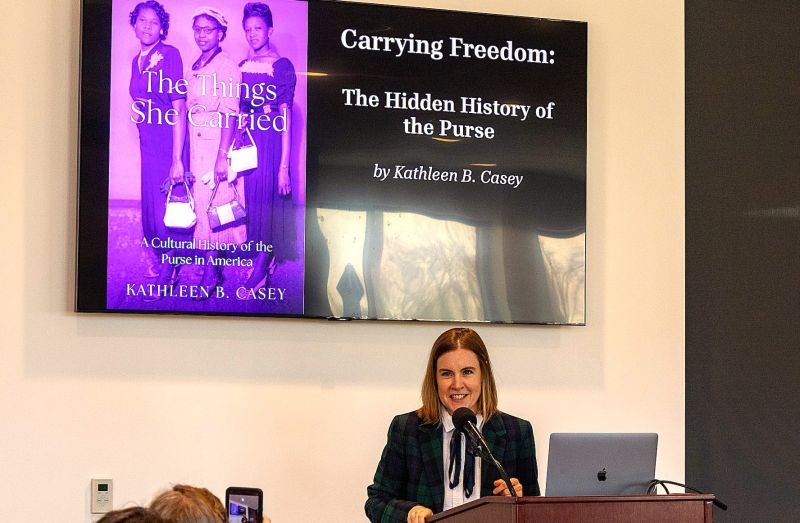 In celebration of Women’s History Month, Virginia Wesleyan University welcomed back former faculty member Kathleen B. Casey, Ph.D. for a thought-provoking lecture that explored the cultural and political history of one of the most familiar everyday objects—the purse. Casey’s talk revealed how something as ordinary as a handbag has carried extraordinary stories of freedom, identity, and resistance across nearly two centuries of American history.
The event, co-sponsored by the VWU Departments of History and Gender, Women, and Sexuality Studies and the Robert Nusbaum Center, featured Casey discussing her newest book, “The Things She Carried: A Cultural History of the Purse in America” (Oxford University Press, 2025).
Casey, who served as a professor at VWU from 2012 to 2023, now directs the Women’s, Gender, and Sexuality Studies Program and serves as Professor of History at Furman University in South Carolina. Her research examines how gender, sexuality, and race are embedded in everyday culture, revealing deeper social meanings in objects and practices often taken for granted.
In both her book and lecture, Casey posits that the purse—often dismissed as a simple fashion accessory—has long functioned as a powerful symbol of autonomy, identity, and resistance. Across nearly two centuries of American history, purses have served as portable private spaces where individuals carried not only the tools of daily life but also symbols of their independence.
“Women were carrying around these itinerant archives all the time,” Casey explained. “I realized I could investigate those archives and understand their lives better.”
During her lecture, Casey described purses as “mobile, deeply personal archives”—objects that exist in public spaces while protecting private lives and identities.
The idea for the book grew from Casey’s own memories. “I can actually remember my first purse,” she told the audience. “I was about five or six years old. It was pink and patent leather with a single zipper across the top and a long, thin strap that I put over my shoulder.”
At the time, she admitted, she had little to carry inside it. “Kids don’t need keys or a wallet,” she said with a laugh. “But it was a way of mimicking what I saw my mother doing.”
As Casey grew older and began studying women’s and gender history, she started questioning why purses were so closely associated with femininity. Had they always been that way? What social meanings were hidden inside such an ordinary object?
Those questions launched a decade-long research project that eventually became “The Things She Carried.” By examining photographs, advertisements, trial records, and personal narratives, Casey uncovered stories about gender, race, privacy, and power embedded in everyday life.
One example she discussed was the 1911 Triangle Shirtwaist Factory fire. During the trial that followed the disaster, purses became an unexpected piece of evidence. Lawyers used a purse in a courtroom demonstration to suggest that female workers might hide stolen garments inside their handbags. The argument helped persuade the all-male jury to sympathize with the factory owners while portraying the women as untrustworthy.
Casey also explained that purses were not always strongly gendered. In the early twentieth century, advertisements promoted both men’s and women’s purses. By the 1920s, however, purses became increasingly associated with women as companies began marketing personal hygiene and beauty products such as cosmetics and sanitary supplies. These items allowed women to remain in public spaces longer because they could carry them discreetly in their handbags. The invention of the first commercial tampon in 1936 further strengthened this connection, particularly during the Great Depression, when many women also carried contraceptive products as they tried to control fertility during difficult economic times.
Purses also appeared in moments of activism and resistance. During the civil rights movement, Black women sometimes used their handbags strategically while navigating the dangers of the Jim Crow South. Some carried protective items—including pistols—for self-defense. In other movements, purses even became improvised tools of protest. Casey noted that activist Marsha P. Johnson reportedly carried a brick in her purse during the Stonewall uprising and threw it at a police car.
Throughout her lecture, Casey emphasized that the most revealing stories often come from ordinary working-class women whose experiences rarely appear in traditional histories. Even public memorials reflect this symbolism. Statues of Rosa Parks across the United States frequently depict her seated with a purse in her lap, representing both respectability and the quiet power of everyday resistance.
For Casey, the purse represents far more than a fashion accessory—it is a container of lived experience. “It’s in public,” she noted, “but it’s also deeply private.”
In closing, Casey encouraged the audience to reconsider everyday objects like purses. These items, she argued, carry hidden stories about women’s lives, identity, and resistance. As she concluded, Casey reminded listeners that it is “high time that we take things like our purses and our bags, open them up, peek inside, and hold them up to the light.”
Learn more about Spring 2026 events hosted by the Robert Nusbaum Center at VWU.