


Share this Story
Freedom to Laugh: Comedy, Taboo, and the Line Between Humor and Harm in the Theatre
Faculty panel explores how humor pushes boundaries—and why it matters
University News | April 9, 2026
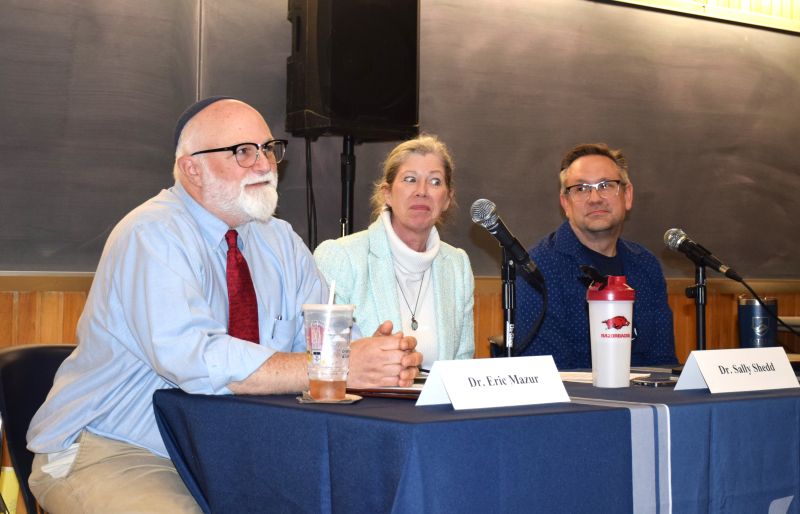 On a night when laughter takes center stage, Virginia Wesleyan University invited an audience to think more deeply about what makes comedy both powerful and provocative. Held on April 9 in Blocker Auditorium—coinciding with opening night of “Avenue Q”—the panel “Freedom to Laugh: Comedy, Taboo, and the Line Between Humor and Harm in the Theatre” challenged attendees to consider the role of humor in a society built on free expression.
Hosted by the Robert Nusbaum Center, the discussion brought together faculty members Travis Malone, Eric Mazur, and Sally Shedd, each offering a distinct lens on comedy’s ability to challenge authority, reveal uncomfortable truths, and, at times, cross into harmful territory. Together, they examined the shifting boundaries of what—and who—humor allows us to laugh at.
From the outset, the panel framed comedy as a space where risk and revelation coexist. Whether it’s a comedian delivering a controversial monologue, a late-night host cloaked in satire, or a stage performer speaking through a puppet, humor often provides cover for saying what might otherwise remain unsaid. But why, the panel asked, do the jokes we “shouldn’t” laugh at so often resonate the most?
Malone, Batten Professor of Theatre and director of VWU’s Avenue Q, described theatre as inherently risky. “Theatre is a dangerous sport,” he noted, emphasizing that comedy, in particular, is not for everyone. He walked the audience through the artistic considerations behind staging Avenue Q—from genre and audience to casting and contemporary relevance—while also reflecting on the musical’s remarkable history, including its Broadway run from 2003 to 2009 and its 2004 Tony Award “Triple Crown” for Best Musical, Best Book, and Best Score.
At its core, Malone explained, Avenue Q resonates because it mirrors the uncertainties of early adulthood. “It’s a coming-of-age story, similar to being in college,” he said. “Avenue Q says the quiet parts out loud.” Through humor, the show distills complex realities into accessible truths, reminding audiences that “everything in life…is only ‘For Now.”
Shedd, Batten Professor of Theatre and Dean of the Susan S. Goode School of Arts and Humanities, placed comedy within a broader historical and cultural framework. Drawing on a line popularized by Caty Borum’s The Revolution Will Be Hilarious, which quotes novelist Tom Robbins, Shedd highlighted the role of playfulness in human progress. “Humanity has advanced…not because it has been sober, responsible, and cautious,” she shared, “but because it has been playful, rebellious, and immature.”
That spirit of rebellion, Shedd argued, has long defined theatrical comedy. From Aristophanes’ Lysistrata to the works of 10th-century playwright Hrosvitha, humor has served as a vehicle for resistance. “Across the centuries, comedy isn’t just entertainment—it’s resistance,” she said. “We gain perspective. We gain distance from authority. And sometimes, we gain solidarity—because laughter, especially in a theatre, is rarely solitary.”
Mazur, Gloria and David Furman Professor of Judaic Studies and Fellow for Religion, Law, and Politics at the Robert Nusbaum Center, explored comedy through the lens of religion and cultural identity, focusing on Jewish humor. “Jewish humor is the language of anxiety,” he explained, describing it as a way of navigating the tension between insider and outsider status.
Referencing Avenue Q, Mazur pointed to a wedding scene in which a traditional Jewish ritual—the breaking of the glass—is reimagined. In the musical, the act underscores the fragility of joy and relationships, even in moments of celebration. “Being an insider confronts being an outsider,” he said. “Avenue Q seeks that magical place where all are accepted—that is Jewish humor.”
Throughout the discussion, panelists returned to a central question: when does humor speak truth to power, and when does it risk reinforcing harm? The answer, they suggested, lies not in avoiding difficult topics, but in engaging them thoughtfully—recognizing comedy’s dual capacity to unite and divide.
The conversation served as a fitting prelude to Avenue Q, a production that embodies the very tensions the panel explored. Running April 9–12 in the Susan S. Goode Fine and Performing Arts Center, the Tony Award-winning musical blends puppet-driven nostalgia with sharp, irreverent commentary on issues such as race, sexuality, mental health, and economic uncertainty.
With its mix of humor and honesty, Avenue Q invites audiences to laugh—even when it feels uncomfortable—and, in doing so, to reflect on the complexities of modern life. As the panel made clear, that uneasy laughter may be where the most meaningful conversations begin.
Visit the Arts at VWU for tickets to Avenue Q.