


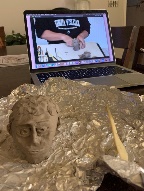
 Phil Guilfoyle developed a Youtube channel to deliver hands on assignments during the remote teaching part of spring semester 2020. Visit Phil's Youtube channel: Pottery Professor
Kahoot and Kahoot Challenge
Denise Wilkinson: This year, I focused on incorporating Kahoot, a web-based student response game platform, into all of my courses to engage students and reinforce the completion of daily assignments. We began the quiz at the start time of class, which reduced tardiness. Students used their phones to complete the web-based quiz by answering multiple choice questions in a game format that included visuals, background music, and a timer. This web-based learning platform has had many benefits. Competitive students enjoyed competing with their peers to become the top candy winners, but in general, students found Kahoot quizzes to be a helpful method to reinforce their knowledge on the topic material with a low stakes grade.
A week prior to VWU transferring to remote learning, Kahoot designed a new offering, "Kahoot Challenge." With this alternate platform, students are able to complete the Kahoot asynchronously, within a given start and ending time frame, and in a timed format. I was able to continue with this course component for the remainder of the semester, which allowed me to stay connected with each student to monitor the engagement in learning the material. If a student did not complete a Kahoot quiz, I reached out to the student to communicate my concerns by email.
Comments on the Spring 2020 semester’s SmartEvals were positive when students were asked “Did you find the Kahoot activities (In-class Kahoots and Remote Kahoot Challenges) to be helpful in your learning for this course? Please explain.” Out of 41 respondents, 93% answered positively. Students shared that they found Kahoot (In-class and Remote) to be a fun, competitive, and helpful way to learn and remember the material in a different format. Learn more at kahoot.com.
Google Meet, Zoom and English 105 Research Strategies
Sherry Matis: During our remote semester, library instruction also continued. Working with English 105 professors to aid in research preparation I used a flipped classroom approach. Students were asked to complete a keyword worksheet and some were asked to watch VWU Library YouTube videos prior to the session. This ensured students were prepared to begin their searching process after the initial modeling of building a search string and performing a basic database search.
Once the courses went remote, the library session was held though Google Meet or Zoom with both the librarian and the ENG105 instructors in attendance. After the initial lesson delivered by the librarian, we used break-out rooms to meet with students either one-on-one or in small groups using Google Meet or Zoom. The instructor and I met with each group checking on their topics and research strategy and answering any questions they had. The interesting part about this was that in the online sessions I seemed to have better questions than in the Face-to-Face sessions I usually do! I have worked with both of these instructors regularly and each experience was a true collaborative effort in the online environment. I met with each of these two ENG105 classes (Ruh & Weinstein) in about three sessions.
In order to meet the needs of different kinds of learners, or in the event that students could not attend the synchronous library instruction session, I also provided the instructors with a "digital handout" (Google Doc) on general research which could be linked in the BlackBoard course. The handout included an outline of topics, bullet points/research tips and links to VWU YouTube videos that would provide more information and/or instruction.