


Consistent with its Mission and Core Values, Virginia Wesleyan University (VWU or the University) is “An inclusive community grounded in the liberal arts and sciences and dedicated to scholarship, service, lifelong learning, and environmental stewardship, Virginia Wesleyan University inspires students to build meaningful lives through engagement in Coastal Virginia’s dynamic metropolitan region, the nation, and the world.” The current strategic plan, Forging Our Future: Building On Strength 2020- 2030, describes a vision under which the College “will be a beacon for the liberal arts in the 21st century.” The plan identifies “academic excellence” as the first of five Core Values. Thus, VWU is committed to continuous improvement of its academic program and student success.
The institution identifies, evaluates, and publishes its goals and outcomes with respect to institutional student achievement by utilizing a coherent and relevant list of multiple measures of success, including: freshman enrollment profile data, retention, course completion, graduation rates, and participation in experiential learning activities. Both main campus and online students are included in the student achievement measures. Success in these achievements relates directly to the Mission of Virginia Wesleyan University.
The following measures have been chosen to monitor student achievement at Virginia Wesleyan University. All measures include campus-based and online students. The University has two off-campus locations and no branch campuses.
Definition: The percentage of entering first-time freshmen who are re-enrolled one year later.
Rationale for Selection: Retention rate is a commonly used measure to determine the extent to which students are making satisfactory progress in meeting their academic goals and progressing to degree completion. Monitoring this measure, along with other related measures, alerts the faculty and administration regarding actions needed to improve support for students to be successful.
Calculation: First-time freshmen entering the University in one fall semester are tracked to determine their subsequent enrollment in the fall semester one year later.
Threshold: The threshold retention rate for first-time freshmen is 62%. This threshold was established based on recent history in retention rates and an analysis of admission, academic support, and student support efforts.
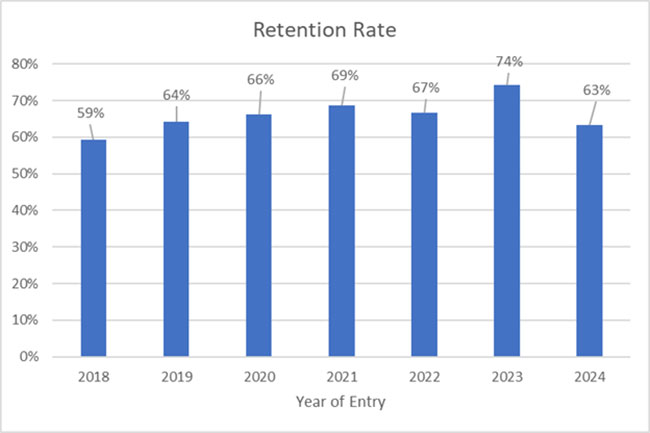
Performance: For freshmen classes entering the University during the period 2018 to 2024, the first year retention rate varied between 59 and 74 percent— a rate most recently near the 50th percentile for Southeastern CIC institutions. (For the period 2014 through 2018, the 50th percentile rate (median) was 68 percent.)
Figure 1, below, “Fall to Fall Retention Rates by Entering Class Year (2018-2023)” charts the retention rates from the year of entry from 2018 - 2024.
This represents improvement in retention over the last 5-year time frame, bringing the institution from below the value for the comparison group to well above the comparison group. Between 2015 and 2024, the institution met the threshold during 8 years, and fell short of the threshold in 2 years (2015 and 2018). During this time frame, the institution has implemented several changes intended to better support students and boost retention.
Figure 1, Fall to Fall Retention Rates by Entering Class Year (2018-2023)" charts the retention rates from the year of entry from 2018 - 2024.
The institution has increased student support on many fronts in the last five to seven years, including enhanced advising for first year and undeclared students, the academic renewal program, improvements to the learning center, tutoring services, instructional technology, and enhanced ability to track students. As part of this, faculty are required to track student attendance in Blackboard, which allows immediate feedback to the advising staff when a student starts to miss class regularly. In these cases, the learning center staff can intervene proactively, without waiting for a faculty member to submit an academic alert. In 2023, the institution received a Title III Strengthening Institutions grant to continue to strengthen this enhanced student support and intervention, with the intent of further supporting student success and retention.
Definition: A course is considered to be completed if the student has not (1) dropped/withdrawn from the course, (2) taken an incomplete grade, or (3) failed the course. While some students must leave a course for unanticipated, personal reasons, there are instances where the University could intervene to support improved completion of courses.
Rationale for Selection: Information on the rate at which students complete courses can help the University identify places in the curriculum delivery where students encounter unusual difficulties. Students who fail or withdraw from courses are less likely to persist because low grades or course withdrawals will extend the time to degree completion. Thus, course completion data can offer insight regarding problems of retention and graduation and guide development of interventions. Internally, completion rates are examined by individual courses to determine if actions with regard to particular courses are necessary.
Calculation: Course registrations and grades are analyzed after the end of the semester. The percentage of registered students who have not dropped/withdrawn, taken an incomplete, or received a failing grade in the course are defined to have completed the course.
Threshold: The threshold course completion of eighty-eight percent (88%) is considered an acceptable target for course completion because some interruptions are outside students’ control, while others might improve with interventions.
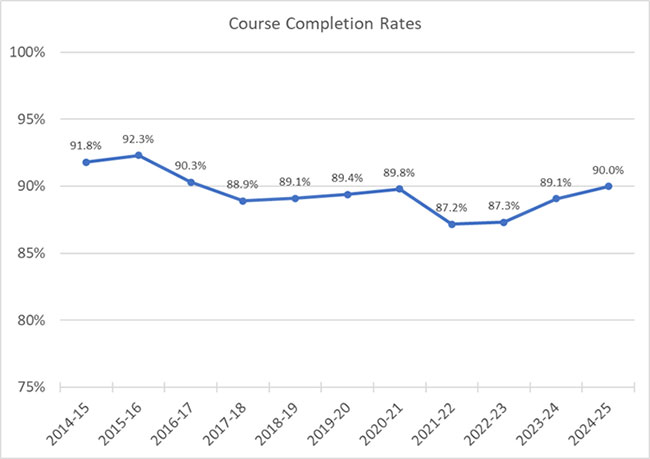
Performance: Figure 2 “Course Completion Rates by Academic Year,” displays course completion rates by academic year (fall and spring) between 2014-15 and 2024-25. During most years (9 of 11 years reported), course completion rates were above the threshold value of 88%. After a decline a few years ago, completion rates have begun to increase in the most recent semesters. The University has made a holistic effort to improve student retention through cooperation of offices across campus. A recently implemented initiative to improve retention is the WesBridge Program, which prepares high school students for success in their university courses. Students in the program are provided the opportunity to jump-start their college education and further develop their academic skills so that their transition into college is as smooth as possible.
In another effort to improve retention, faculty submit Academic Alerts when they observe patterns in coursework that cause concern. The Academic Alerts provide the opportunity to intervene and assist, and when appropriate provide referrals for counseling, tutoring, and advising services to enable such students to succeed in their coursework. The purpose of the system is to help every student successfully complete courses, and the reporting and recordkeeping are strictly non-punitive. This system is now overseen by the Associate Vice President for Student Success, who works under the direction of the Vice President for Enrollment and Student Success.
The Associate Vice President for Student Success works in concert with the Care Team, which brings together information from Academics, Campus Life, Student Health Services, Residence Life, Athletics, and Financial Aid to help support student success.
Figure 2 Course Completion Rates by Academic Year
Definition: The percentage of full-time first-time students (entering freshmen) who earn a bachelor’s degree in six years after entry.
Rationale for Selection: Graduation rate is a commonly used measure to determine the extent to which students are making satisfactory progress in meeting their academic goals and progressing toward degree completion. Monitoring this measure, along with other related measures, alerts the faculty and administration regarding actions needed to improve support for students to be successful. Examination of data by gender, race, and socioeconomic status, provide detailed information to assist the faculty in targeting needed student support efforts.
Calculation: First-time freshmen entering the University in one fall semester are tracked to the end of what would be their sixth year of enrollment to determine whether or not they have earned a bachelor’s degree.
Threshold: The target threshold for graduation rate is 48 percent. This threshold was established based on history of retention rates, recent graduation rates, and an analysis of admission, academic support, and student support efforts.
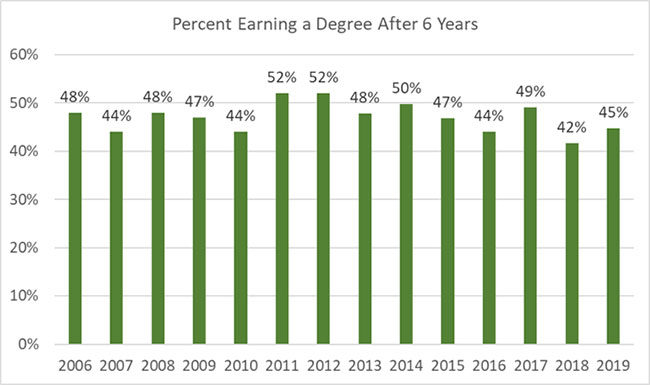
Performance: Over the past fourteen cohorts, the University’s graduation rates have ranged from 42% to 52%. Since the 2006 cohort, VWU has achieved this threshold for 7 cohorts, and has fallen short of the threshold 7 times. The 2013 cohort’s rate of 48% is above the 50th percentile for our group of Peer institutions; for the period 2009 through 2013, the median rate for the peer group was 47 percent. See Figure 3 below.
Figure 3 Six-Year Graduation Rates by Entering Class Year
As previously discussed, several interventions have been applied to improve retention, student academic success, and graduation. Student support service has expanded during the pandemic. The University received a Title III grant to help serve underrepresented populations. This enabled the hiring of a Student Success Coordinator and a Coordinator of Student Professional Development. The Student Success Coordinator focuses her efforts on the first two years, and supporting students to build successful foundations and succeed through their underclass years. The Coordinator of Student Professional Development focuses on upperclass students and helping them to transfer their classroom knowledge into professional pursuits so that they are prepared for post-graduation success.
It is important to note that a) the reported graduation rate has been consistently tracked by the VWU Office of Institutional Research, and b) the reported graduation rate by definition includes a time lag of six years. Thus, the most recent year reported in Figure 3 is the 2019 cohort (those that graduated by spring 2025), whereas the retention rate data reported in Figure 1 begins with the retention rate for that 2018 cohort. During 2018, the freshman to sophomore retention rate was 59%, and the six year graduation rate for that cohort was 42%. With improvements to the retention rates in subsequent years (from 59% to 74% and then back to 63%, Figure 1), we would anticipate that the six year graduation rate should show similar patterns in the coming years.
Definition: Contemporary pedagogical research has identified the “high impact practices” that most effectively impact student engagement and thereby contribute to persistence and student success. Many of the “high impact practices” are various types of courses and course activities that result in experiential learning, which means learning by doing rather than by absorption and comprehension of information. Three prominent high-impact practices have become an important focus in the VWU curriculum by virtue of their centrality to the University’s comprehensive curricular reform of 2011, and the focus of the 2015 Quality Enhancement Plan (QEP). These include Internship courses, undertaking Study Away experiences, and performing Undergraduate Research.
Rationale for Selection: Following from the 2015 QEP, enhancing student participation in experiential learning has persisted as a meaningful measure of student achievement for VWU. Strengthening participation in the three experiences directly serves the first of the six goals of VWU’s Strategic Plan, to provide a transformative educational experience.
VWU highly values experiential learning experiences and expects that they enhance student graduation rates. These high impact practices help students to transfer classroom knowledge into professional settings. Students who participate in these types of experiences are more engaged, thus this data allows us to consider which students are accessing these resources and how these connect to other measures.
Calculation: Graduating seniors’ successful completion of a course specifically associated with one or more of the internships and study away were tracked. Participation in research with a faculty member were tallied from faculty records. Percentages of total graduating class were calculated.
Thresholds: Until stability of offerings has been reestablished following the COVID epidemic, thresholds will remain at 2019-20 levels. The threshold for internships is 38% participation.
The threshold for research is 24% participation. The threshold for study away is 4 percent participation. The threshold for completion of at least one experience is 58%.
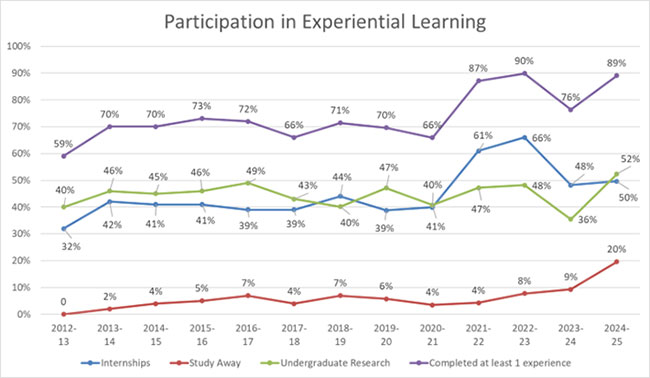
Performance: With the 2015 pilot implementation of the Quality Enhancement Plan and full implementation in 2016, increases on experiential learning measures were expected. Figure 4 (below) illustrates that participation rates have fluctuated considerably across measures, with 2019-20 reaching a particular low point on all. The 2019-20 performance included the semester that COVID-19 became widespread. Since that time, the participation in experiential learning activities has rebounded, and actually has exceeded the values observed during 2010-2021, for Internships, Study Away, and All Activities Combined.
The University continues to be committed to experiential learning. As stated in the University mission, VWU strives to “inspire students to build meaningful lives through engagement in Coastal Virginia’s dynamic metropolitan region, the nation, and the world.” Experiential learning is coordinated through the Office of Global Engagement, the Office of Community Engagement, the Office of Undergraduate Research, and the Office of Career Development. All of these offices are centrally located at the Athenaeum: Center for Exploration & Discovery, which is located in the VWU Hofheimer Library.
All experiential learning programs collect data and assess progress to inform future efforts. The new General Education program launched in 2019 is anchored in developmentally sequenced seminars, structures analogous to curricular successes of the previous QEP. Both the University’s core curriculum and experiential learning now have scaffolded developmental structures to more effectively support students. Many departments have implemented major requirements that explicitly require one of the Experiential Learning Courses, such as an Internship or Research course. Some departments have a longer history of involving students in undergraduate research, whereas others historically had students conduct more internships. Many departments utilized the resources devoted as part of the 2015 QEP, in order to add opportunities in these areas, especially in areas where the department could add to student opportunities for experiential learning. Some departments had been historically strong in undergraduate research, and added internship opportunities. Other departments found ways to add research and study away courses. In this aspect, the 2015 QEP was successful in promoting additional experiential learning opportunities across departments. In many ways, these experiential learning opportunities have become embedded in the VWU culture and the structure of many academic programs. The data in Figure 4 suggest that the institution is moving in the right direction on this metric, despite the setbacks introduced by the COVID-19 pandemic.
Figure 4 Graduates Who Completed a Mastery Level Experiential Course, 2010-11 to 2023-25
The recent development of the Batten & Black School for International Studies allows VWU students the opportunity to study abroad at the University’s collaborative campus in Tokyo, Japan. VWU Students first participated in this experience in the Urban Ecology class during the summer of 2024; the following summer, this opportunity was expanded to include four VWU courses. Through these types of global opportunities, VWU aims to continue to expand opportunities for global engagement and other experiential high impact practices for all VWU students.